Cabinet refacing vs replacing
The cabinet boxes settle this more often than the doors do. If they are sound and in the right place, refacing is usually the better buy. If not, new cabinets are.
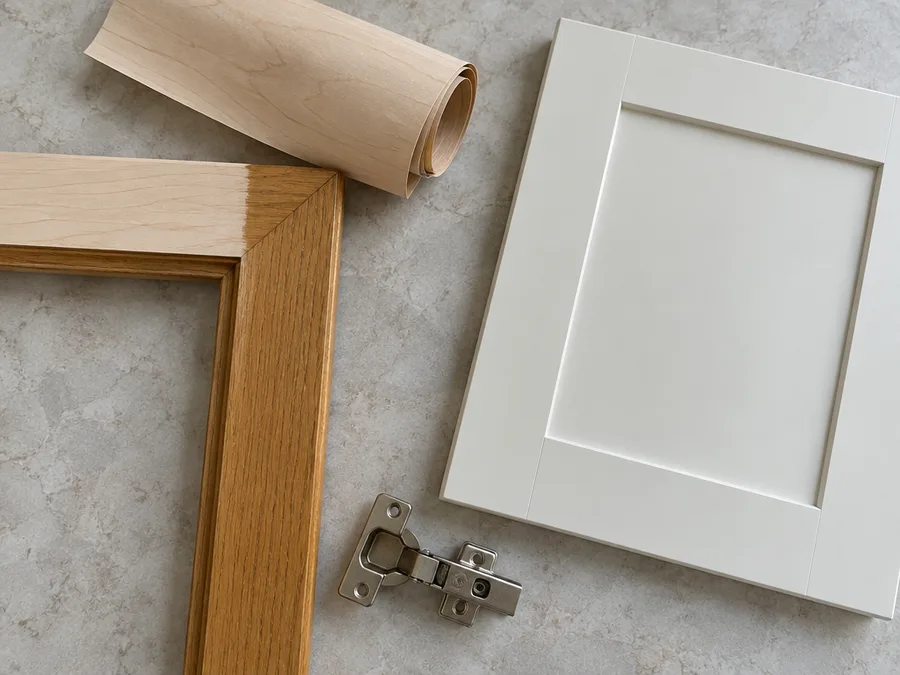
Cabinet refacing and cabinet replacement give you new-looking cabinets, and on a quote they can land within a few thousand dollars of each other. They are still different jobs. Refacing keeps every cabinet box where it is and replaces what you see: the doors, the drawer fronts and a thin skin over the face frames. Replacing takes the boxes out, which usually means the countertop comes off first, and puts new ones in, in the same places or in new ones.
So most of the decision is about the boxes, not the doors. Three questions settle it for most kitchens. Are the boxes sound? Is the layout staying? And how far apart are the two real prices once everything each job drags in is counted? This guide goes through all three, plus the cheaper third option of refinishing the doors you have. The cabinet refacing page covers what a refacing job includes line by line; this page is about choosing between the two.
Is it better to reface or replace cabinets?
Neither is better in general. Each is right for a particular kind of kitchen, and most kitchens are clearly one kind or the other once you look at them honestly. Fixr sums up the rule the way most cost guides do: refacing "is only possible if your current cabinets are structurally sound and have smooth, clean surfaces", and replacing is "the best choice if your existing cabinets have significant structural damage or if you want to change your kitchen's layout."
That gives you a short table to work through before anyone quotes.
| What you find | Points toward | Why |
|---|---|---|
| Boxes solid, layout works, only the style has dated | Refacing | You pay for new fronts and keep everything that still works |
| Doors in good shape, only the color is wrong | Refinishing or painting | Neither the doors nor the boxes need replacing |
| Sink base swollen, soft or delaminating | Replacing, at least that box | A new door needs a sound box to hang on |
| Sink, range or a wall is moving | Replacing | Refacing keeps every box in its current place |
| You want drawers where the doors are, or taller uppers | Replacing | Refacing can't change a box's size or its insides |
| Refacing quote close to a stock-cabinet quote | Price both in full | At that point the new boxes cost you very little extra |
Most kitchens land in one row. The hard ones are the last row, where the money is close, and the kitchen whose boxes are fine apart from one damaged cabinet under the sink. For the second, ask whether that box can be replaced on its own and faced to match the rest of the run. If it can, you are refacing a kitchen with one new cabinet in it, and the decision gets easy again.
Cabinet refacing vs replacing cost
The published ranges for refacing and replacing overlap more than most people expect. Here are the two cost guides that price all three options side by side.
| Source | Job | Typical range |
|---|---|---|
| Fixr, January 2026 | Refinishing (strip, sand, restain or paint) | $2,000 to $4,500 |
| Fixr, January 2026 | Refacing | $3,000 to $13,500 |
| Fixr, January 2026 | Replacing the cabinets | $4,000 to $15,000 or more |
| HomeGuide, 2026 prices | Refinishing | $1,500 to $4,500 |
| HomeGuide, 2026 prices | New doors and drawer fronts only | $2,200 to $6,600 |
| HomeGuide, 2026 prices | Refacing | $5,000 to $13,000 |
| HomeGuide, 2026 prices | Full cabinet replacement | $4,500 to $15,000 |
Read those rows carefully and the top of the refacing range sits above the bottom of the replacement range, in both sources. That is not a mistake. A refacing job in solid wood across a long run can cost more than a set of stock boxes in a small kitchen. The ranges tell you the two jobs compete. They can't tell you which is cheaper in your kitchen.
What the ranges leave out matters more. The replacement figures are for the cabinets. Fixr says plainly that replacing cabinets "may require you to replace your countertops or backsplash as well", because base cabinets can't come out from under a countertop that stays on. Bob Vila adds new flooring to the list where the old cabinets stood, and moved light fixtures where the new layout calls for them. None of those costs appear on a refacing job, which leaves the counter, the backsplash and the floor exactly where they are.
The countertop is usually the biggest of them. Fixr says a typical 10 by 10 kitchen has about 40 square feet of countertop, and prices replacement at $1,600 to $6,000 for that much at $40 to $150 a square foot. So a replacement quote that doesn't mention the counter is missing a line, not offering a better price. The countertops page goes through what a new top costs by material.
What is the average cost to reface a 10x10 kitchen cabinet?
A "10x10 kitchen" is 100 square feet of floor, and in the cost guides that makes it a small kitchen. Fixr's small band is anything under 150 square feet, which it expects to hold somewhere between 16 and 25 linear feet of cabinets. For that band it prices refacing at $4,400 to $6,875.
You can check that against the per-foot figures. Fixr's average is $275 per linear foot of cabinets, within a range of $100 to $450 depending on materials. At 20 feet of cabinets, which sits in the middle of the small band, that works out to about $5,500 at the average, $2,000 at the cheapest and $9,000 at the most expensive. Laminate fronts pull a 10x10 job toward the bottom of that spread and solid wood toward the top.
A real 10x10 quote can still land away from that arithmetic. The count of fronts is one reason. Fixr also gives an average of $435 per door, so a small kitchen with a lot of narrow doors and drawer stacks can cost more than its footage suggests. Add-ons are the other, and Fixr notes they can add a few hundred dollars to a total: crown molding, glass-front doors or lighting under the uppers.
What is the downside of cabinet refacing?
The main one is that refacing keeps what you can't see. The boxes, their floors, their shelves and the way they are joined together all stay, so any fault inside them stays as well. The rest of the downsides follow from that.
It can't change the layout or add storage. HomeGuide lists both among the cons of refacing: the boxes stay the same size, so there is no extra storage, and the kitchen layout can't change. If your frustration is a corner cabinet you can't reach or a run of doors where you want drawers, new fronts won't fix it.
The materials also age at different rates. Fixr says laminate, the cheapest refacing material, "can peel over time, especially with exposure to moisture", that wood veneer can separate and can't be refinished, and that solid wood holds up best and can be refinished later. HomeGuide says temperature and moisture swings can make veneer or laminate expand and contract until it cracks or warps. A refacing quote in laminate and one in wood veneer are not the same product at a different price.
Then there is the skill involved. Bob Vila says refacing is "considered more challenging than installing cabinets", because the materials take time to get familiar with. Veneer that is cut short or lifting shows first at the edges of the face frames and around each door, which is where to look on any finished example a remodeler offers to show you.
Last, the price can drift up to replacement money. As the cost table shows, a high-end refacing job and a stock-cabinet replacement can meet. Once they do, the replacement also gets you new boxes inside, and refacing's advantage is mostly that it leaves the countertop alone.
None of this makes refacing a bad buy. It makes it a good buy for sound boxes in a layout you like, and a poor one for anything else. The refacing page's own section on when it is the wrong answer gives the sink-base test in more detail.
Is cabinet refacing worth the money?
Worth depends on what refacing costs against the alternative, covered above, and on what it gets back if you sell. For resale, the most useful figures are the Cost vs Value report from the Journal of Light Construction and Zonda, which prices the same model projects in each market and then asks how much of the cost the project adds to the resale value.
Its "minor kitchen remodel" is close to a refacing job. The report describes it as leaving "cabinet boxes in place but replace fronts with new shaker-style wood panels and drawer fronts", together with new appliances, a new laminate countertop, a new sink and faucet, new flooring and paint, in a 200-square-foot kitchen. Its "major kitchen remodel" puts in new semi-custom cabinets and an island instead.
| Source | Project | Resale value added | Share of cost recouped |
|---|---|---|---|
| Cost vs Value, Denver 2024 | Minor remodel, boxes kept | $21,337 | 82.4% |
| Cost vs Value, Denver 2024 | Major remodel, new cabinets | $31,544 | 39.6% |
| Cost vs Value, Mountain 2025 | Minor remodel, boxes kept | $31,417 | 110.3% |
| Cost vs Value, Mountain 2025 | Major remodel, new cabinets | $40,218 | 49.3% |
The job that kept the boxes got back roughly twice the share of its cost that the job that replaced them did, in both years. The bigger remodel still added more dollars at resale. But it cost about three times as much, so each dollar spent on it added less.
Those are figures for whole model projects, so treat them as a direction rather than a price for your kitchen. The minor remodel includes appliances, a countertop and a floor as well as the new fronts, and nothing in the report isolates refacing on its own. The cost guides that do give refacing its own figure are vaguer about where it comes from: HomeGuide says refacing returns 60% to 75% "depending on the new materials used", and Bob Vila gives 65 to 75 percent, without naming a method.
Resale is only half of worth, though. If you will be in the house for another fifteen years, the question is whether the kitchen works, and a refaced kitchen with a layout you dislike is money spent on a room you still won't enjoy.
Refinishing: the third option
Refinishing, painting included, keeps even more than refacing does. The doors, the frames and the boxes all stay, and only the finish changes. Fixr describes it as stripping the existing finish, sanding, and then applying a new stain or paint, and puts it at $2,000 to $4,500 for a standard kitchen. It also sets a limit that rules out many kitchens straight away: refinishing "is only suitable for solid wood or some plywood cabinets."
That limit is the real test. By Fixr's own rule, laminate and thermofoil doors are out, and a door style you dislike stays the same style in any color. So refinishing suits a kitchen whose doors are solid wood, undamaged and a shape you are happy to keep. Refacing suits one whose boxes are good but whose doors are the wrong material or the wrong style. Replacing suits one where the boxes are the problem. The refacing page covers cabinet painting against refacing in more depth, with Fixr's painting prices.
Check the cabinets yourself before anyone quotes
A refacing price only holds if the boxes are sound, and you can find out most of what a remodeler would look for in ten minutes with the doors open and a flashlight. It is worth doing before the first visit, because it tells you which of the two quotes to take seriously.
- Open the sink base first. Press on the cabinet floor near the back, where the pipes come through. It should be flat and hard. Swelling, a soft spot, a stain line or layers lifting apart mean water has got into it, and a new door on that box is money spent on a failing frame.
- Look at the shelves. A shelf that sags in the middle, or whose supports have pulled out of the side panels, tells you what the box material has been through.
- Check the joints and the wall line. Look at where each box meets its neighbor and where the uppers meet the wall. Gaps that have opened, or uppers that have dropped away from the wall at the top, are structural problems that no amount of veneer will cover.
- Find out what the face frames are made of. Look at the edge of a frame where a door hinges on it. Solid wood takes veneer well; a frame that is itself a thin laminate over particleboard, with chipped edges, is a poorer base.
- Note what you want to move. List anything you want in a different place: the sink, the range, the refrigerator gap, an island. Each item on that list pushes the decision toward replacing.
- Count the fronts. Count every door and drawer front and measure the runs in feet. With those numbers you can check any refacing quote against the per-door and per-foot figures above.
If the first three checks come back clean and the list in step 5 is empty, refacing is the job to price first. If any of the first three fail across more than one box, get a replacement price before you spend time on refacing samples.
What new cabinet boxes are made of, and the label to look for
Replacing gets you new boxes, and what they are built from is a choice of its own. HomeGuide's cabinet cost guide notes that plywood cabinets with solid wood doors typically cost more than laminate or medium-density fiberboard (MDF) ones. Plywood, MDF and particleboard are all covered by a federal rule.
The EPA's formaldehyde emission standards for composite wood products, under Title VI of the Toxic Substances Control Act, set limits on how much formaldehyde hardwood plywood, MDF and particleboard can give off. The EPA says that since March 22, 2019, composite wood products sold in the United States "must be labeled as TSCA Title VI compliant", and that these products include "hardwood plywood, medium-density fiberboard, and particleboard, as well as household and other finished goods containing these products."
For a buyer that turns into one easy question. When new cabinets are quoted, ask whether the boxes are plywood, MDF or particleboard, and whether the cabinets or their panels carry the TSCA Title VI compliance label. It says nothing about how well the cabinets are built, but a supplier who can't answer it is telling you something about how much they know about what they sell.
Refacing avoids the question for the boxes, since they stay. New doors and drawer fronts made from MDF are composite wood as well, so the same question applies to them.
What happens to the cabinets you take out
Replacing puts a full set of cabinets out of the house, and in Aurora there is somewhere for sound ones to go other than a dumpster. The kitchen cabinets page names the local reuse store that sells secondhand kitchen cabinet sets, with what its own pages say about donations. Cabinets that come out whole, rather than in pieces, are the ones worth offering, so tell whoever quotes the removal that you would like them taken out intact.
Refacing, by contrast, sends almost nothing out of the house but the old doors and drawer fronts. HomeGuide counts that among refacing's advantages, as "more environmentally friendly", and Fixr says the same: the boxes are reused instead of being sent to a landfill.
If you are working out the whole budget rather than just the cabinets, the guide to what a kitchen remodel costs in Aurora puts both scopes in context. For how long each takes and in what order the work runs, see how long a kitchen remodel takes.
Sources
- Cabinet Refacing Cost · Fixr, updated January 26, 2026 · opened September 25, 2026
- Cabinet Refacing Cost · HomeGuide, 2026 prices · opened September 25, 2026
- Cabinet Refacing Cost · Bob Vila, updated May 1, 2024 · opened September 25, 2026
- Cost to Reface Cabinets · HomeAdvisor, updated June 20, 2026 · opened September 25, 2026
- Kitchen Cabinets Cost · HomeGuide · opened September 25, 2026
- Formaldehyde Emission Standards for Composite Wood Products · U.S. Environmental Protection Agency · opened September 26, 2026
- Kitchen Countertop Installation Cost · Fixr, updated January 28, 2026 · opened September 25, 2026
- Cost vs Value 2024, Denver, minor kitchen remodel, midrange · Journal of Light Construction and Zonda · opened September 25, 2026
- Cost vs Value 2024, Denver, major kitchen remodel, midrange · Journal of Light Construction and Zonda · opened September 25, 2026
- Cost vs Value 2025, Mountain region, minor kitchen remodel, midrange · Journal of Light Construction and Zonda · opened September 25, 2026
- Cost vs Value 2025, Mountain region, major kitchen remodel, midrange · Journal of Light Construction and Zonda · opened September 25, 2026
Refacing or replacing, other questions
Can I replace just the cabinet doors?
Yes. HomeAdvisor describes it as fitting new doors and drawer fronts without covering the cabinet boxes, which suits frames that already look right. HomeGuide prices door replacement at $2,200 to $6,600, below its refacing range, because nobody veneers the frames. The catch is the match. New doors beside old frames in a different color or wood show the difference at every gap, so it works best when the frames will be painted or already match.
How long do refaced cabinets last?
The two cost guides that answer it disagree by a few years. Fixr says 10 to 20 years or more with good materials and installation, and HomeGuide says 15 to 30 years for professionally applied veneers. Both put the material first. Fixr ranks laminate as the shortest lived and solid wood as the most durable, and HomeGuide warns that swings in temperature and moisture can crack or warp a veneer while cooking smoke and grease dull it.
Can I reface kitchen cabinets myself?
You can, but the saving is smaller than it looks. Fixr puts the labor share of a professional job at $4,125 to $5,775 and says a DIY attempt needs precision, special tools and real skill. Bob Vila goes further and calls refacing more demanding than installing new cabinets, since the materials take time to learn, and warns that mistakes can quickly eat into whatever a DIY job saved.
Does refacing include the inside of the cabinets?
No. HomeGuide defines refacing as replacing the exterior surfaces only, and lists "doesn't add storage space" among its cons. Shelves, drawer boxes and the cabinet floors stay as they are unless you pay for them as add-ons, such as new drawer boxes or roll-out shelves. If the inside is the part that bothers you, price new cabinets as well.
How do I compare a refacing quote with a replacement quote?
Ask both for the same kitchen in the same terms. Each should give the number of doors and drawer fronts, the linear feet of cabinets, and the door material. The replacement quote should also say what happens to the countertop and the floor under the old boxes. Put the countertop in the refacing total as "kept" and in the replacement total as a real line, then compare. The new kitchen cabinets page lists what a replacement quote usually leaves out.
Still between the two?
Describe the cabinets as they are, including what the sink base looks like inside. Both prices can then be worked out against the same kitchen.